Robert’s description book
The EmigrantsRobert’s description book gives the Nilsson family a way to picture North America before any of them has seen it, converting scattered reports about a distant country into routes, resources, and possibilities they can discuss at home. It is more than a store of information: as Robert reads from it, the imagined landscape becomes part of the household’s preparations, while the voyage gradually tests the confidence that its pages have helped create.
A country carried into the cottage
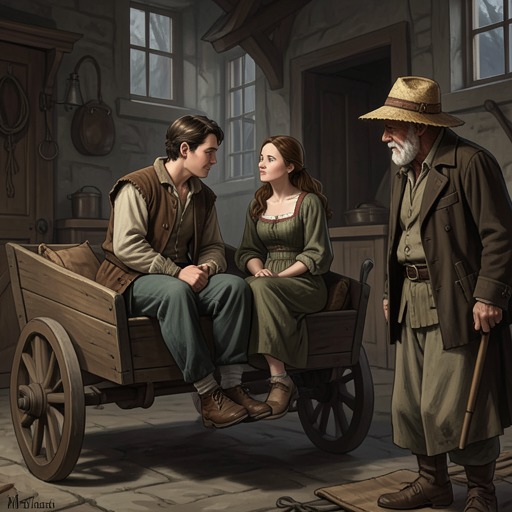
The book enters the family’s deliberations through Robert, who returns to the parental home after a year’s service in Duvemåla. He has not merely heard rumors about the United States; through the book, he has learned to picture its lakes, rivers, plains, mountains, and roads, both on land and water. He insists that he will not get lost when he reaches the New World. Now he shares what he has learned with his brother and sister-in-law, reading aloud during the long winter evenings and giving Karl Oskar new information day by day.
The book’s authority rests on detail, but its information reaches a community that has never seen or explored the country it describes. For people whose inherited life is rooted in small plots and familiar customs, reports of fertile land and opportunity make emigration imaginable; the book gives those reports a more ordered shape. The new country remains distant and uncertain, yet it can now be considered through particular landscapes, resources, and routes rather than as an indistinct rumor.
The promise of roads and resources
One of the book’s most striking subjects is the railroad. Its account explains the wooden crossbars and iron rails, the wheels fitted with inner rims to keep a wagon on track, and the steam engine that pulls several connected carriages. It describes travel at twelve to eighteen miles an hour or faster, bridges that let passengers walk between cars, and a comfort room in every carriage. The reported total—8,000 miles of railroad—makes the scale of American transportation seem almost as important as the fertile land that first drew attention to the country.
The descriptions also include claims of abundant pasture, wild horses and oxen, plentiful game and fish, and freedoms from certain familiar Swedish burdens, including taxes and catechism examinations. These reports make America sound materially generous and less constrained by established authority. Kristina responds to the account of steam travel with delight at the thought of riding in a wagon without a beast pulling it. Her pleasure gives the book’s technical description a domestic dimension: its distant inventions become a subject of shared conversation and anticipation.
Yet the book’s promise is not the same as firsthand knowledge. The family has no traveler ahead of them who can verify what awaits, and even the railroad account is something Robert reads rather than something they have experienced. Its information helps them plan, but the certainty of the prose sits beside the uncertainty of the decision. The book enlarges what the family can imagine without making the unfamiliar country fully knowable.
From reading to departure
The information Robert carries helps make a collective decision practically conceivable. Karl Oskar and Robert write to a firm in Karlshamn and secure passage for six people aboard the merchant vessel Charlotta, paying a hundred daler in advance. The intended departure is in the second week of April, when the family can hope to arrive early enough in summer to till and sow. Robert is also to write for Danjel and obtain a passage contract if the ship has room. The book does not by itself arrange the voyage, but its picture of the destination belongs to a chain of reading, discussion, financing, and transport that turns the prospect of emigration into a plan.
The family’s preparations show how selectively they must translate information into material choices. Their old oak clothes chest, once kept among the household’s inherited possessions, is brought out to become a packing case for the journey. Tools, hunting equipment, and fishing gear are packed with the expectation that American land and waters will offer work and resources; bedding, food, clothing, and remedies are chosen for a passage whose conditions cannot be fully predicted. The book’s descriptions therefore reach beyond conversation: they inform what the emigrants believe may be useful in the country ahead, even as the chest has to accommodate only what can be carried.
The limits of the imagined map
On the road out of the parish, Robert counts each gate as he jumps down to open it, making the journey toward America legible one threshold at a time. The gesture echoes the book’s mapped routes, but the emigrants’ departure is also marked by what they leave: Karl Oskar looks back at his parents standing on the porch, while he and Kristina watch familiar places they expect not to see again. The book can supply an imagined geography of the destination; it cannot make the passage out of home emotionally simple.
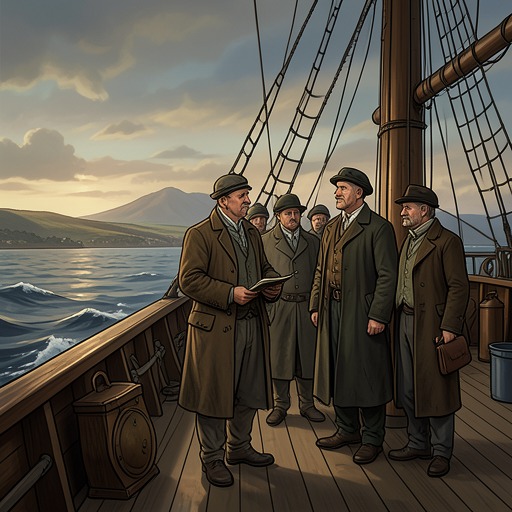
At the harbor, the family encounters water without land visible on the other side. Aboard the Charlotta, Robert and Arvid measure the vessel and find it only forty paces long and eight wide, with nearly a hundred people expected to live, sleep, eat, and attend to daily needs aboard. The cramped ship is a sharp counterpoint to the railroads’ speed and comfort as described in the book. The written account has made movement across America seem expansive; the emigrants’ immediate experience is movement constrained by a small vessel and the open sea.
Contrary winds extend the crossing, and the passengers begin to suspect that they were misled about the distance. They measure the journey not in miles but in the long days since they left Karlshamn in the second week of April. Their old home and their intended new home both seem remote. This delay does not disprove the book’s descriptions of America, but it reveals the limit of what those descriptions can do: a map of the destination cannot shorten an ocean crossing or guarantee the travelers’ arrival.
A book in the larger story of migration
Robert’s description book stands at the hinge between information and action. Rumors of another continent first disturb settled expectations; the book gives those rumors names, routes, technologies, and material prospects; conversation and planning then connect the imagined destination to the Charlotta and the family’s departure. In this way, the object makes visible how migration can begin before travel, within a home where a distant place is read into being and weighed against familiar obligations.
Its influence remains distinct from direct experience. The family’s confidence draws on what Robert has read, but their journey brings new realities that no description of the destination can absorb: departure from parents, exposure to the sea, crowded quarters, and the long uncertainty of adverse winds. The book is thus both a tool of orientation and a measure of distance. It lets Robert and Karl Oskar imagine roads across North America, while the emigrants must first cross an ocean whose days cannot be reduced to the routes on a page.